


Burden Museum & Gardens
Welcome Center
Conceived as a threshold, the Burden Museum & Gardens Welcome Center establishes a formal entry to the Burden Museum & Gardens campus through a series of simple, legible forms—architecture deliberately embedded in the landscape to frame, heighten, and ultimately reveal it.
LOCATION
SIZE
SERVICES
Awards
COLLABORATORS
Photographer

View across event lawn

Central dogtrot-style breezeway, a local architectural vernacular
Located on the former estate of Steele Burden—former LSU landscape architect in the early to mid-20th century who shaped more than 400 acres through careful stewardship and collection of artifacts—the site holds deep cultural, agricultural, and ecological significance. Donated to LSU and now stewarded by multiple entities, the Burden property functions simultaneously as a public garden, a living museum, and a research landscape for the LSU AgCenter Botanic Gardens at Burden. The Welcome Center establishes a clear and legible front door to this expansive campus, addressing the long-standing challenge of welcoming and orienting visitors within a site that is freely accessible and largely unmeasured.

Site plan of new Welcome Center on Burden Museum & Gardens campus in Baton Rouge


Diagram illustrating roof runoff exiting the east façade scupper, landing at the splash block, and continuing into the surrounding site
The design is deeply informed by water, both as a functional system and a visible teaching tool. Roof runoff is collected and directed into rain gardens, where water is slowed, observed, and released back into the regional watershed. Permeable gravel parking supports stormwater management while reinforcing the agricultural values of the site. A large, expressive roof scupper on the east façade visibly discharges stormwater onto a splash block at the building’s base, turning rainfall into a moment of discovery and revealing the volume and movement of water by reinforcing the project’s connection to research, stewardship, and land-based learning.

Back event lawn
Material choices reinforce the project’s emphasis on craft, durability, and responsible stewardship, a set of values that mirror the LSU AgCenter’s mission of research, education, and service to the citizens of Louisiana. Locally sourced cypress is used extensively throughout the interior, celebrating regional building traditions while reducing embodied carbon and reinforcing a long-term commitment to resource conservation.
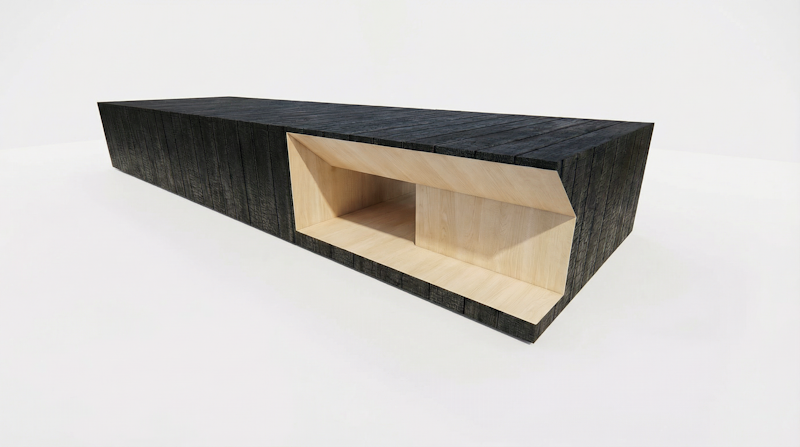
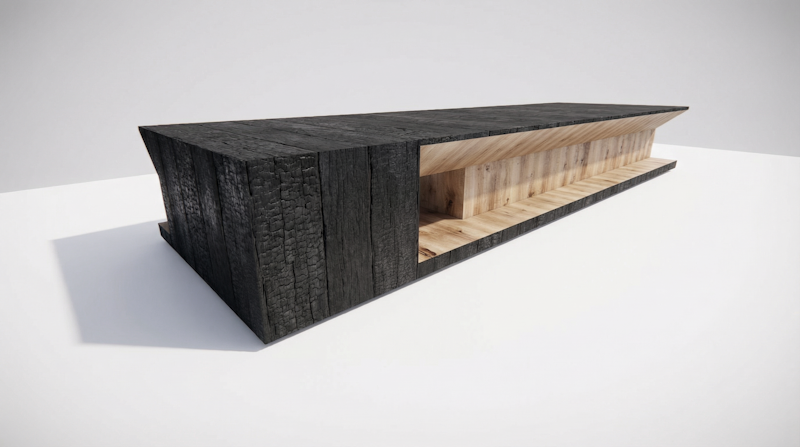
Massing axonometry and material concept, inspired by carving into a charred block of wood to reveal warmth, depth, and interior space

Floor plan of Burden Welcome Center


Rendering: Interior view of multi-use event space
